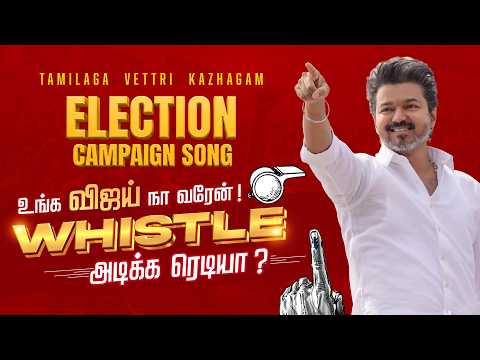
Origin Story
The story of TVK begins not in 2024, but in 2009, when Thalapathy Vijay first transformed his 85,000+ fan clubs into the Makkal Iyakkam (People's Movement) — a welfare organisation that served Tamil Nadu's poorest communities through blood donation, disaster relief, education and environmental work.
For 15 years, Vijay watched Tamil Nadu politics from a distance — but never stayed silent when injustice occurred. The Mersal controversy of 2017, where political pressure was applied to censor his film's dialogues on healthcare, was a turning point. His refusal to comply signalled that he would not be intimidated.
By 2023, with Tamil Nadu still dominated by two legacy parties exchanging power every five years, Vijay made his decision. He would not just campaign for change — he would become the change. On 2 February 2024 — in a ceremony watched by millions — the Tamilaga Vettri Kazhagam was officially born.
"This party belongs to the people of Tamil Nadu. It is not built on caste, religion or dynasty. It stands on Social Justice, Egalitarianism and the welfare of every Tamil person."
— Thalapathy Vijay, TVK Founding Declaration, 2 February 2024
Identity
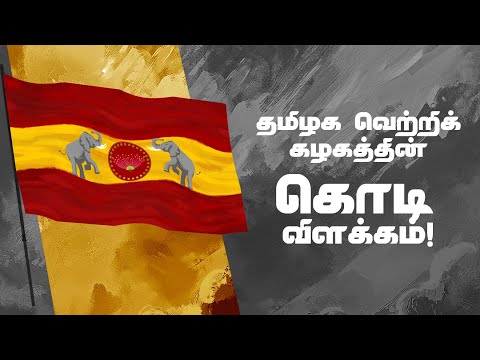
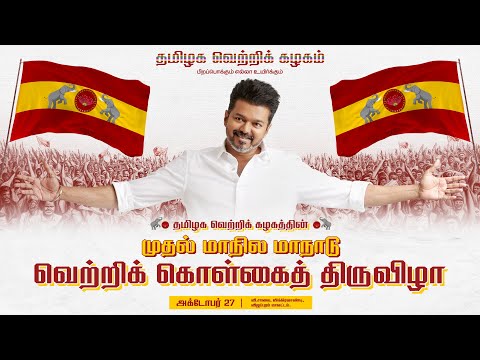
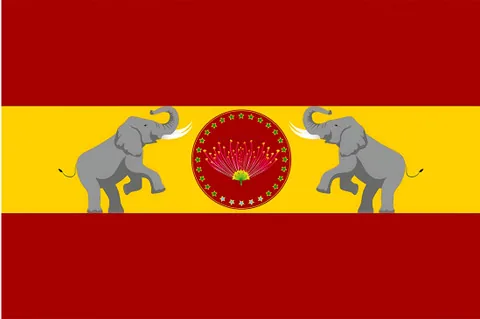
Three horizontal stripes · Two elephants · Vaagai flower in centre
Maroon represents the blood, sacrifice and determination of the Tamil people. Gold/Yellow represents prosperity, justice and the bright future TVK envisions for Tamil Nadu.
The elephant symbolises strength, wisdom, memory and loyalty. Two elephants facing each other represent unity — the union of the party and its people, working together toward shared prosperity. In Tamil culture, elephants are sacred and auspicious.
The Vaagai (Albizia) flower holds deep significance in Tamil culture as the flower of victory. In ancient Tamil tradition, victorious warriors and rulers wore Vaagai garlands. TVK chose it as the centrepiece of its flag — a declaration that this party exists to win for the people.
Core Beliefs
Every Tamil person — regardless of caste, religion or economic background — deserves equal access to education, healthcare, employment and dignity. TVK was founded on this principle above all others. No discrimination. No hierarchy. One Tamil Nadu.
All people are equal. TVK rejects systems that place some citizens above others by birth or background. Governance must serve the many, not the few. Every policy decision must ask: does this benefit ordinary Tamil people?
Religion is personal. Governance is for everyone. TVK stands firmly for a Tamil Nadu where no person faces discrimination because of their faith, and where the state remains neutral and fair to all communities without exception.
Government exists to serve people — not to enrich political families or corporate allies. Every rupee of public money must be spent transparently on public welfare. Accountability is non-negotiable.
No Tamil child should be denied education due to poverty. NEET must be abolished. State-controlled education must return. Tamil Nadu produced India's finest doctors before NEET — and will again.
Tamil language, culture and people must be protected and celebrated. State rights under the federal structure must be defended. Tamil Nadu must have control over its own education, agriculture and resources.
"TVK is not a platform for one person's ambition. It is the collective voice of 8 crore Tamil people who deserve better — better governance, better healthcare, better education, better livelihoods."
— TVK Founding Statement, 2 February 2024
2009 – 2026
Vijay formally converts his fan network into the Makkal Iyakkam welfare movement. Blood donation, disaster relief, education scholarships, food drives — Tamil Nadu's largest organised non-governmental welfare network is born. This becomes TVK's grassroots foundation years later.
When Chennai faced its worst floods in a century, Vijay and his network deployed thousands of volunteers across the city — providing food, rescue assistance and rehabilitation support to hundreds of thousands of families. This operation demonstrated the movement's genuine people power.
When the ruling party demanded that dialogues criticising GST on medical services be cut from the film Mersal, Vijay publicly refused. The country watched. Tamil Nadu stood behind him. This was the moment millions understood that Vijay would not be a puppet — he had a political spine.
During COVID-19, Vijay donated crores from his personal funds and organised the largest civil relief operation in Tamil Nadu. Food distribution, oxygen concentrator procurement, hospital support and mental health resources — all coordinated through the Makkal Iyakkam network.
In a ceremony watched live by millions across Tamil Nadu and the world, Thalapathy Vijay formally launches TVK. The maroon-gold-maroon flag with two elephants and Vaagai flower is hoisted for the first time. The party's founding principles — Social Justice, Egalitarianism, Secularism — are declared. Tamil Nadu politics is changed forever.
TVK's first state conference at Vikravandi, Villupuram district. Over 800,000 people attended — one of the largest political gatherings in Tamil Nadu history. 26 landmark resolutions passed. Vijay's first major political address as TVK president. The world watched.
TVK's second major conference in Madurai — the cultural capital of Tamil Nadu. Vijay presented TVK's complete 22-point election manifesto: free bus travel for women, TASMAC reform, NEET abolition, farmer MSP, government jobs, anti-corruption measures. The manifesto was specific, measurable and people-centred.
In its very first-ever election, TVK won 108 assembly seats — enough to form a majority government. A party that didn't exist 27 months ago had become the ruling party of Tamil Nadu's 8 crore people. Vijay personally won from both Perambur and Tiruchirappalli East constituencies.
At JN Indoor Stadium, Chennai — with national leaders including Rahul Gandhi in attendance — Thalapathy Vijay was sworn in as the 13th Chief Minister of Tamil Nadu. 59 years of DMK-AIADMK alternation was broken. TVK's journey from founding to governance in 27 months is now complete.
Historic Gatherings
Villupuram District, Tamil Nadu
TVK's first and historic state conference. Over 800,000 people attended — making it one of the largest political gatherings in Tamil Nadu history. The conference marked TVK's formal entry into Tamil Nadu's political arena with a clear agenda and people's mandate.
Key Resolutions Passed
+ 21 more resolutions covering healthcare, fishermen, education, environment and more
Held in Madurai — the cultural heart of Tamil Nadu — TVK's second conference was where Vijay presented the complete 22-point election manifesto. Unlike political promises that are vague, TVK's manifesto was specific, time-bound and measurable. It covered every section of Tamil society: women, farmers, students, workers, fishermen and the poor.
Manifesto Highlights
4 May 2026
No first-time party in Indian democratic history had achieved this. Founded in February 2024, TVK went from a brand-new political party to the ruling government of India's 6th largest state in just 27 months.
Since 10 May 2026
Free bus travel + free LPG cylinders + monthly financial aid announced in the first cabinet meeting. Immediate rollout began.
Government order issued for complete audit of all ~5,400 TASMAC shops across all 38 districts. 3-month timeline.
Formal petition filed in Supreme Court to restore Education to the State List and abolish NEET for medical admissions in Tamil Nadu.
TNPSC drives active. First batch of 40,000 posts from 1.2 lakh vacant government positions now being filled.
Government order issued revising MSP rates upward for mango, paddy and other key Tamil Nadu crops. Especially benefiting 5 key agricultural districts.
Full public report on 100 days of TVK governance to be published — transparent accountability on every promise made to Tamil Nadu's people.
"Tamil Nadu waited 59 years for a genuine alternative. TVK isn't just another party. It's proof that the people — when united — can break any dynasty, any monopoly, any injustice."
— Tamil Nadu political analyst, post-election 2026
State Conferences
Official Videos
From cinema legend to Chief Minister — every chapter